|
Show All / Hide All
 | Is my child ready for kindergarten? My Father's World Kindergarten is designed for a child that is ready to begin to read. My Father's World usually recommends waiting until a child is five years old before beginning Kindergarten. Some older four year olds are ready for Kindergarten so it's important to carefully discern readiness. - Is he ready to sit down and do 20 - 30 minutes of written work daily?
- Does she have the manual dexterity to begin writing letters and words and is she interested in doing so?
- Is your child already taking time to sit down to draw and color?
- Is he excited about starting school?
If the answer is yes to these questions then your child is probably ready to start Kindergarten. |  | Is my child ready for 1st grade? A child should have a strong foundation in these skills to move into 1st grade:
* Does your child know the 26 letter sounds (consonants and short vowels)? Letter names are not as important.
* Is your child able to generally print the alphabet letters correctly? Is he generally able to place his letters accurately on kindergarten-sized lined paper?
* Can he easily read short words such as "hat," "pig," and "men" without your help and without any accompanying pictures? (Was he taught how to blend sounds, not just memorize words?)
* Is he developmentally able to sit long enough to copy 4-6 short words on kindergarten-sized lined paper without complaining or becoming tearful?
* Is your child mature enough to sit cooperatively for 20-30 minute segments for structured school activities? (My Father's World First Grade will take about 2 hours each day to complete.)
If you can answer, yes, to the above questions your child is ready for 1st grade. If they are not, we recommend that you begin with My Father's World from A to Z kindergarten curriculum. |  | How do I teach a preschooler, kindergartner, and 1st grader together? In pre-school, K and 1st grade, the differences in children's abilities are great. We recommend working individually with each child on phonics, hand writing, and math skills. Children in pre-school will benefit from 15 minutes of one-on-one parent time working on pre-writing and math skills. Children in K and 1st grade will need 30-60 minutes of individual parent time to work on reading, writing and math. Specific skills will be addressed in each child's age appropriate curriculum. We recommend My Father's World Kindergarten and First Grade Deluxe packages along with our Preschool package. Please see How to Teach K and 1st Together for more information about using these programs together. School can be completed for all three in children in 2½ - 3½ hours each day. Please see How to Teach K and 1st Together |  | How does MFW teach phonics in kindergarten? My Father's World uses a multi-sensory approach to reading that involves children learning to blend both beginning sounds and ending sounds. In My Father's World Kindergarten, sounds are introduced first that are the easiest for children to pronounce as well as the most efficient way to begin reading words. Students learn to read words and sentences and will make 11 small books throughout the year from which to read. The thematic units build on each other and have been designed to be introduced with learning to read in mind.
Reading is taught by having students blend consonants before and after the short vowel sounds helping children to put sounds and words together. My Father's World has intentionally chosen to introduce the blending of sounds and words without rhyming so that kids are not memorizing the words based on a pattern. Blending with a mix of beginning and ending sounds help insure they are learning to read. Our goal by the end of Kindergarten is to have a child easily reading all short vowels in words and sentences. Blending of sounds and reading begins in lesson 6 giving students lots of time to practice reading before moving to My Father's World First Grade.
My Father's First Grade will complete phonics and reading instruction. All phonics needed to become an independent reader will be learned during this year.
|  | Is My Father's World curriculum accredited? My Father's World provides complete curriculum for preschool through high school. There is no accreditation process available for curriculum. Schools can be accredited and teachers can be accredited. The author of My Father's World, Marie Hazell, is an accredited teacher and has worked at accredited schools. My Father's World curriculum is used by some accredited schools. A curriculum can be called accredited when it is used through an accredited school and a student is registered to use that curriculum through that accredited school. Curriculum cannot be accredited independently. |  | What is the length of MFW Kindergarten? The K program begins with a 10 day overview of creation followed by 26 lessons taking 6 days each, not six days per week. This is a total of 166 days or approx 33 weeks which is considered a full school year. Each daily lesson plan will take 60-90 minutes to complete. |  | How can I use My Father's World Kindergarten with my reading child? Children that are reading when entering Kindergarten can still benefit greatly from My Father's World Kindergarten. They will spend the year learning about the Creation story from Genesis followed by 26 hands-on, thematic units that will focus on the wonders in God's creation. The sun, moon, rocks, vegetables, elephants, butterflies and dinosaurs are just a few topics they will discover. Handwriting will be learned throughout the program this year. They will also learn math skills including counting, writing numerals, preparing and understanding charts and graphs, clocks, money and an introduction to addition and subtraction. To further challenge an advanced reader:
- Use the reading time as a handwriting and beginning composition program which will focus on simple spelling and some mechanics of writing through copy work and dictation.
- Beginning with lesson 6, use the word list, choose 3-5 words as a spelling list. Dictate these words to your child as they write the works on K-lined paper. Immediately correct those that are wrong and have your child copy them again.
- If your child can read a specific sentence, use that sentence as copy work having your child use their very best handwriting.
- If copy work is too easy, you may dictate the sentence to your child after looking over the sentence with him or her. If this is too difficult be sure and stop, waiting until a later grade to begin dictation.
- Add readers at your child's reading level to continue you child's progress. Honey for a Child's Heart is a great resource for grade level books and is available through My Father's World.
- Continue to use the math, Bible, science, literature and character development and reading books about the lesson theme scheduled in the Teacher's Manual.
|  | Why does My Father's World First Grade reading have such a rapid pace? There are many factors that go into the decision to pace First Grade as written. First and foremost, My Father's World First Grade assumes that a child has been sounding out short vowel words for nearly 9 months as scheduled in My Father's World Kindergarten. In K, a child begins sounding out their first words near the end of the 2nd month. Many people think that MFW K moves too slowly. We receive calls often from moms who want to find shortcuts to teaching short vowels so their child can start 1st Grade. We believe that in K it is better to provide a firm foundation so that they can move at a faster pace with confidence as they transition into 1st grade. Children enjoy new information and can grasp concepts quickly if they have had the K foundation. Expecting total mastery of a subject before moving on discourages a child and holds them back unnecessarily once they have that foundation.
So what do we suggest if your child is struggling with the pace in 1st grade? We would suggest repeating the phonic portion of a lesson 2-4 times daily. You can consider returning to the K curriculum for a better foundation if your child is still struggling. You can also try teaching the 1st grade phonics three times a week with a review day in between.
Dad can help by entertaining all the kids when he gets home so you can spend one-on-one uninterrupted time in the evening for a final review or possibly teaching phonics entirely at that time. (The Hazells had a child who at age 7 seemed like he would never learn to read. He not only learned to read but received academic scholarships to a major university. He also doubled his curriculum in high school and had enough credits to graduate by age 16. He dually enrolled into college and entered university with 28 or more college credits toward his major.)
Please exercise caution when you are discouraged by a child not succeeding as quickly as you would like. Don't give up but press on in a gentle way. All of a sudden, one day out of the blue, children finally get it. The Hazells were most of the way through 1st Grade when their 3rd child finally understood blending and all the sounds. The next day he seemed to remember everything he earlier struggled with and became a fluent reader in a matter of weeks. |  | Do you recommend using Singapore math with a first grader? My Father's World First Grade curriculum is a complete program which includes math. 1st grade math will focus on real life, hands-on activities and can be supplemented with The Complete Book of Math which is included in the deluxe package for skills reinforcement. We have found delaying a child's move into a textbook based, formal math program and focusing on hands-on math is beneficial in helping children understand abstract concepts in math and number relationships. Based on observation and experience we recommend beginning Singapore Primary Math in 2nd grade. Your child can take a placement test at that time to determine where they would begin. Many of My Father's World families have been pleased at the placement of their children after following our 1st grade program as written. The Teacher's Manual will list twenty specific goals for numbers, addition, subtraction, place value, money, time, and other foundational math concepts. Our First Grade Teacher's Manual also features a library book list of math literature. |  | Can I purchase the reading portion of the First Grade package? Our First Grade is a complete curriculum, focusing on language arts, math, science and Bible. The Bible and language arts are integrated together as a unit study with the Bible as the focus. The teacher's instructions for all the subjects including phonics are in one Teacher's Manual and are not available separately. For a broader and more complete education we recommend the items in the deluxe package which include read aloud recommendations, art, music, and math enrichment materials.
Workbooks are available separately, but are not helpful without the instruction found in the Teacher's Manual. The complete Student Materials for 1st grade can be purchased individually, but again are not complete without the instruction in the Teacher's Manual. We have the Bible Reader, Student Workbook, Student Worksheets and the Bible Notebook available. |  | Can I order individual items from the First Grade Student Materials? Yes, individual items may be purchased by calling our office at 573-426-4600. A package of First Grade Student Materials ($44.95) contains all the consumable materials you need for additional children using the program. If you have more than one child using the 1st grade you will need one package of materials for each student. Each piece is an important part of the overall program. The First Grade Student Materials include:
Bible Reader ($14.95) - many children prefer to keep their first Bible Reader
Student Workbook ($14.95) - phonics exercises
Student Worksheets ($13.95) - hands-on phonics activities, handwriting, timeline figures, math and reading charts
Bible Notebook ($8.95) - for writing composition and illustrating Bible stories |  | When will younger children study American History if they skip Adventures? We recommend each of your children begin by completing My Father's World Kindergarten from A-Z and My Father's World First Grade. As each child enters 2nd grade they will join the oldest child in the program they are currently using in the five year cycle. Once a 2nd grader enters the five year cycle they continue rotating through the cycle until they reach 9th grade. This allows you to teach only one program a year and promotes family learning. The United States history taught in Adventures will be covered again in Exploration to 1850 and 1850 to Modern Times in greater detail. For children entering the cycle in 2nd or 3rd grade during these years, a supplement is required using many books from Adventures. Younger children will not miss anything, but will study the content at another time.
Each child begins school by completing Kindergarten and First Grade focusing on the reading, handwriting, and math portions of those younger programs. They can be invited to join the older kids for Bible, science, read alouds, and other hands-on projects from the program the oldest children are using. This allows younger children to glean and learn some of the content too.
The sequence for your oldest child is:
Kindergarten
First Grade
2nd - Adventures
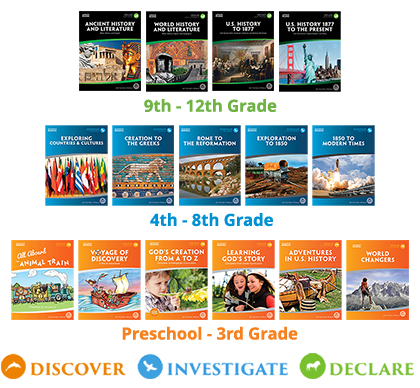
3rd - Exploring Countries and Cultures
4th - Creation to the Greeks
5th - Rome to the Reformation
6th - Exploration to 1850
7th - 1850 to Modern Times
8th - Exploring Countries and Cultures (at a more advanced level)
Transition to My Father's World high school program
Please look at the Family Cycle for more information. |  | Why should I use Adventures before beginning the Family Cycle? As the authors of My Father's World, Adventures is the only program that we have written that was not directly needed by our family. We overlooked a need that arose several years into the development of our programs. It became evident that oldest children needed one more year of maturity before being able to handle the content and workload of Creation to the Greeks. We discovered two reasons for this situation. First, parents put more pressure on oldest children and thus find it difficult to skip advanced projects intended for 4th-8th graders. As long as moms have one child in this range it seems that younger children do fine because mom has an older child to direct more difficult projects toward. Secondly, part of the content in Creation to Greeks is teaching of pagan culture and comparing it to the Old Testament laws of God. This is very abstract content and again seemed better targeted to 4th graders who had another year of maturity, reading practice, and writing experience.
Adventures developed as a result of these concerns. We wanted to give families a cultural overview of the most important events of US History before beginning chronological history. We have found that homeschoolers often focus on the Greeks, Romans, Babylonians, and the Middle Ages so much so that the oldest child in the family has had no US History before junior high.
Adventures is designed for the time when families have 2nd or 3rd graders with no older siblings in 4th - 8th grade. Younger children will study the content of Adventures with their older siblings during Exploration to 1850 and 1850 to Modern Times. For 2nd and 3rd graders entering the cycle during these years a 2nd/3rd grade supplement uses many books from Adventures. |  | What is the Celebrate America booklet? The publisher no longer supplies the booklet for Celebrate America. The booklet contained sheet music for each of the songs and some history about the songs. The sheet music for each of the songs is now included on the CD in separate PDF files with the exception of God Bless America.
In our revised Adventures Teacher's Manual, we have included the short commentary from the booklet about the songs being studied. For example, on God Bless America, Monday, week 1, includes a box that begins "Irving Berlin...". You may also choose to check the internet for some background on the songs. Here is some information we found about God Bless America . If you have an older version of the Teacher's Manual that you purchased from My Father's World, you may trade in your Teacher's Manual for the updated version for $45.00 by calling our office 573-426-4600. |  | When should I put my child in Adventures? Adventures in My Father's World is designed for the time when families have 2nd or 3rd graders with no older siblings in 4th - 8th grade. 2nd or 3rd graders with older siblings should skip Adventures and join their siblings in the current program of the Five-Year Cycle. This ensures that a parent is teaching only one program for 2nd - 8th graders.
After several years into the development of our programs it became evident that oldest children needed one more year of maturity before being able to handle the content of and workload of Creation to the Greeks. We have found that oldest children who are going into 4th grade better understand the history in Creation to the Greeks. This does not seem to be a problem with younger siblings as they have an older child to help them on their way.
Younger children will study the content of Adventures with their older siblings during Exploration to 1850 and 1850 to Modern Times. For 2nd and 3rd graders entering the cycle during these years a 2nd/3rd grade supplement will use many books from Adventures. |  | Is my child ready for Adventures? - Can your child write or copy 1-2 sentences fairly easily and cheerfully?
- If you were to read the story of David and Goliath to your child, would he or she be able to write several simple sentences about the story?
- Have your child read a sample from our First Grade Bible Reader. Can they read it fairly easily? It is normal at this age to still be sounding out words.
- If you are considering Adventures for an advanced six-year-old, are they prepared to spend 3 - 3½ hours each day doing school?
If you can answer yes to these questions your child is probably ready for Adventures. If not, we would recommend My Father's World First Grade. If your child is younger than six years old, please call My Father's World at 573-426-4600 so we may speak with you specifically regarding your situation. |  | Can younger children join in with Adventures? You may invite your younger children to join in the activities that interest them in the Adventures program. To easily incorporate younger children, we recommend purchasing an additional set of student sheets and a US/world placemat map for each child ages 3-7. Adventures may be completed in 3 to 3.5 hours a day, including 60 minutes of independent work, when using our math and language arts recommendations. During that independent work, we suggest that you work with younger siblings on their phonics and math, using either MFW K or MFW First Grade. |  | How can I help my child who is having difficulty completing, I Can Do All Things? The Adventures Teacher's Manual encourages you to help foster your child's love of art by keeping the atmosphere light and positive. After the Introduction to Drawing is finished, the lessons will begin to alternate weekly between remaining chapters or topics. The lesson plans schedules 3 lessons per week. I Can Do All Things will not be completed during this year since it contains over 180 lessons and may be continued into the summer or the following year if you choose. We encourage you to do art at least once a week to develop some of these skills presented in the book. Continuing through the lessons to introduce different aspects of art is an important part of your child's education. By doing so you may find that your child is not really interested in drawing, but loves to paint. |  | Why a year of Geography? My Father's World's Exploring Countries and Cultures (ECC) is an integrated geography program that prepares the student to more effectively retain history and more detailed geography during the following years of chronological history. In our opinion, teaching history and geography at the same time without a previous foundation in geography causes overload and a lack of retention for the student. During ECC, students will study the book of Matthew which helps families to understand and embrace God's heart for His people and His creation prior to studying history, allowing history to be seen and understood from God's perspective.
At the completion of the year, students should be able to label at least 100 countries from memory. They will have studied the culture of people groups around the world, ecosystems on each of the continents, prayed specifically for the countries studied and read biographies of those who served as missionaries in those countries.
My Father's World has two main goals for students going through ECC. First, to help families develop God's heart for the world and teaching a Biblical worldview that is others focused. The second is to study geography and international cultures. |  | When do I begin Exploring Countries and Cultures? My Father's World recommends that the oldest child start with Adventures in My Father's World if they are in 2nd or 3rd grade. Once Adventures is completed in 2nd or 3rd grade, Exploring Countries and Cultures is the next step in the cycle. If your child is in 4th grade or above, My Father's World recommends starting your child in the five-year cycle with Year 1, Exploring Countries and Cultures.
If you have an older student, My Father's World recommends that new families begin with year one, Exploring Countries and Cultures for all the children in your home in grades 2-8. To insure that it is an interesting and challenging program for 7th and 8th graders, you will need to purchase the 7th and 8th grade supplement for Exploring Countries and Cultures. The 2nd Edition Teacher's Manual schedules all of these supplements. |  | What is the book schedule for the 7th and 8th grade supplement in ECC 2nd edition? The second edition Exploring Countries and Cultures schedules the books (and Progeny Press literature guides) as follows:
- Progeny Press literature guides - Weeks 1-8
- Bruchko (South America) - Weeks 9-11
- The Narrow Road (Europe) - Weeks 12-16
- Progeny Press literature guides - Weeks 17-22
- I Dared to Call Him Father (Asia—Pakistan) - Weeks 23-26
- Peace Child (Asia—Indonesia) - Weeks 29-34
|  | Why do we begin the Family Cycle with Exploring Countries and Cultures (geography)? We recommend families with an oldest child entering 4th grade or above begin with Exploring Countries and Cultures. All children in the home between 2nd and 8th grade will benefit from Exploring Countries and Cultures. We believe that teaching geography first allows the child to better understand and retain their future study of history. The Biblical focus during this year is a study of the book of Matthew. The focus helps families to understand and embrace God's heart for all His people prior to studying chronological history. This allows history to be seen and understood from God's perspective. Exploring Countries and Cultures will help your family understand a Biblical worldview that is others focused, allowing your family to discover God's great love for the world.
To further challenge 7th and 8th graders we offer a supplement which is scheduled in the Teacher's Manual. One of our customers answered this question by commenting, "Exploring Countries and Cultures is all about teaching a Biblical worldview that places the emphasis on others. It teaches us that the United States isn't the only country that God loves. God loves all the people groups of the earth and it helps us to learn to love them too." — Dawn H. |  | Why is Story of the World Vol.1 not used? My Father's World uses the resources that best present the information. For the time period of Creation to the Greeks we believe the most accurate and ancient "original document" is the Bible. God gave us a great history book that is full of action, intrigue, motives both good and evil, and His interpretation of events and people. We want to lay a foundation for kids to see God at work in history so that they can study further history with a correct perspective. The Bible is used as the main history spine for the entire year with other books supplementing as needed. We want kids to hear God's incredible words to mankind.
Most of the information in Story to the World Vol. 1 is contained in other books that we use in Creation to the Greeks, so it is not necessary for this year. The following years of the history cycle use Story of the World Vol. 2 - 4, as we think the author has a wonderful storytelling style that makes history come alive. |  | Why is Streams of Civilization used? We use Streams of Civilization Volume 1 as a resource for parents and for older students so that they can understand history from a Christian perspective. How did we get different races after the flood if there was only Noah and his family? Who were the Hittites? We don't read every page—just the relevant information. |  | When is American Government studied in the Family Cycle? During Year 4, Exploration to 1850, the first part of American history is covered and students are introduced to: the Declaration of Independence, the Constitution, and the three branches of government. You read about the process and people involved in forming our government in George Washington's World. This gives a basic overview of how our country's government was formed. A more in-depth study of U.S. government is covered in year 3 of our high school program. |  | Why does Samuel come after Samson in the timeline? Please refer to the notes in week 19 of your Creation to the Greeks Teacher's Manual for an explanation. The dates represent the time around which it is thought that these men were born, so Samuel was already living when Samson was born. We just do not hear his story until 1 Samuel. |  | What view of creation science is presented in Creation to the Greeks? As a company we hold to a literal 6-day creation and this belief is reflected in our programs. We also understand this is a topic of debate in the Christian community. Our goal is to hold to our beliefs without excluding anyone from using our curriculum. This is a decision that each family and ultimately each person needs to make. The Bible is handled much in the same way. Scriptures and other books are provided, but interpretation is left up to each family. |  | Why do we study Rome in-depth? We believe that spending ample time in this period of history helps students better understand the political and social climate that Jesus was born into. As students learn about Jesus, His ministry, and the New Testament along side the history of the Roman Empire, it brings even more meaning to God's Word. Understanding Rome and its fall brings students to a clearer understanding of the foundations of the Christian Church, which will play an important part in later history. |  | Why have we chosen to use Augustus Caesar's World? One of My Father's World goals is to help families see the characters of the Bible, including Jesus, in the context of all of history. Reading Augustus Caesar's World places Jesus in historical context. Studying the Bible and other Christian books along side of a secular book like Augustus Caesar's World allows history and all other subjects to be taught from a Biblical worldview. The Teacher's Manual provides recommendations for how to use Augustus Caesar's World for multiple children in multiple grades in Notes, Week 1, Thursday. We hope a Christian book that teaches about Jesus in a solid historical context becomes available soon. |  | My 2nd and 3rd graders don't seem to be understanding Augustus Caesar's World. Please remember that siblings in 2nd or 3rd grade will go through the five-year cycle again as older students. They do not need to catch everything the first time through the cycle. We suggest asking younger siblings to color while listening or splitting the reading into two smaller segments. We have found that younger siblings benefit from hearing the readings even if they are quietly coloring, playing with Legos, Play Doh or other quiet games. They will increase their vocabulary and at least gain a familiarity with the names and events even if they do not understand all the details. We suggest filling your book basket with books that allow your younger children to get a flavor for the time period. Younger children will enjoy other books in the program such as, The Roman Empire, Ancient World, Medieval World, and later in the year The Story of the World Volume 2.
We would also encourage younger children to create a notebook page, even if it is a simple drawing, labeled with the date and a brief summary. For students who are struggling to write a summary they may dictate a one or two sentence summary to you. Their dictation can be used as copywork. |  | What is the 2nd and 3rd grade supplement for Exploration to 1850? These are key "living books" from Adventures in My Father's World, designed specifically for 2nd and 3rd graders, to help make history come alive for younger students. All of these books are conveniently scheduled in the Teacher's Manual. They are great books, and you won't want to miss any of them. |  | What is the 2nd and 3rd grade supplement for 1850-Modern Times? Because the history portion is more difficult to understand for 2nd and 3rd graders, My Father's World has created a 2nd-3rd Grade Supplement for 1850 to Modern Times that you will need to teach history to your younger students during this year. Fascinating literature books as well as two activity books help make American history and U.S. geography come alive for younger students. You will find all of these books conveniently scheduled in your Teacher's Manual. They are great books, and you won't want to miss any of them! |  | Why is the history in 1850 to Modern Times difficult for 2nd and 3rd graders? The content of 1850 to Modern Times is difficult for 2nd and 3rd graders. The information is more difficult to understand than in our other history programs; many of the books are written at a higher comprehension level. The history content is often troubling—describing wars and human cruelty—and not suitable for younger students. The author of The Story of the World does not recommend using Volume 4 with 3rd grade or younger, and we agree. However, 2nd and 3rd graders can still join you for Bible, science experiments, science readings (the easier sections), and president and state studies, along with the 2nd and 3rd grade supplement that help make American History and U.S. geography come alive for younger students. (Remember that 2nd and 3rd graders will have an opportunity to repeat 1850 to Modern Times in 7th or 8th grade, when they will have the maturity needed to fully comprehend the complex information.) |  | How long will it take to receive the ants and butterflies after sending in the certificate? The delivery time is 2-3 weeks for the ant and butterfly orders depending on weather. The ants are used in lesson 11 and the butterflies are studied in lesson 21 in the K curriculum. |  | What are the benefits of the Deluxe Package? We recommend purchasing the deluxe package to provide the broadest and most complete education for your children. All of the items in the deluxe packages are scheduled or explained in the Teacher's Manuals. Deluxe packages include read alouds, music, art, as well as items to enrich the year's study. The basic package was created as a consideration for customers who were unable to purchase all the items in the deluxe package. The basic package will give your child a good, solid education. You may choose to purchase individual items from the deluxe package. |  | What version of the Bible do we use in My Father's World? Kindergarten: The NIV is used for many of the Bible verses. We also use the New Century Version, an easier version to understand, for verses that are more difficult for young children to understand.
The student materials do not have any Bible verses printed on them. The Teacher's Manual has verses you read to the child, printed for your convenience, as well as the reference. If you prefer, you may use any version of the Bible when you teach the program, and read the verses from your own Bible.
First Grade: The NIV is used for the memory verses, which all come from Proverbs. We use the CEV for most of the Bible stories. The NCV is used for the Creation story. These are simplified versions that make it much easier for children to understand the Bible stories.
The student materials do not have any Bible verses printed on them. The Teacher's Manual has memory verses printed in large type so that the student may copy them for handwriting practice; you will need to write these verses out for your student to copy, if you use another version. The Teacher's Manual also has many Bible stories printed so that you may read them directly out of the manual, but the reference is provided if you prefer to read them from your own Bible.
The 2nd through 12 grade programs use the NIV. Memory verses are printed in the Teacher's Manual and a list of the year's verses is provided for your convenience. You may use any version of the Bible when you teach the program, reading and copying the verses from your own Bible.
My Father's World supports Bible Translation around the world through, God's Word for the Nations, a nonprofit, tax exempt organization. We have a great love for God's word, and understand the need to communicate clearly and accurately to those you are reaching. |  | When do students begin book reports? We do not schedule book reports during any of our curriculum years. We summarize stories and write about people, places and events we are learning about in history, science, and the Bible. My Father's World recommends language arts that include dictations, copy work, creative writing and formal composition. We believe that book reports often have a negative effect. Reading becomes more of an assignment to complete a report than for the enjoyment of reading a quality book. In 7th and 8th grade, we recommend Progeny Press study guides to help students further develop skills in critical thinking, comprehension, literary analysis, and Christian application while reading quality literature. |  | How can I see a copy of the library book lists in the Teacher's Manual? These book lists are only available as a part of an MFW Teacher's Manual and are not available individually. My Father's World has put a great deal of time and research into selecting the books for each of our programs. Unfortunately there are people who request our book lists to recreate our programs. If we allow this to happen we will no longer be able to provide the curriculum so many families are enjoying.
Each of our Teacher's Manuals for 2nd - 8th grades recommends 300-400 books and are organized in two separate lists. Book basket books are themed to weekly topics being studied. A second list of classic books is organized by grade level. These books are read cover to cover when assigned by a parent during independent reading time.
|  | What is My Father's World's copyright policy? Selling new curriculum provides the resources My Father's World needs to continue to develop the quality programs you are enjoying. We are continually updating our current programs as publishers update and change the books. We have completed a credit-based high school program that meets high school graduation and college entrance requirements.
The daily lesson plans in the Teacher's Manuals are designed to be written in to make record keeping easier. If you have multiple children using the program we allow you to copy the lesson plans for record keeping for each child. We offer the copying option to meet the needs of your family, not so that you can have a clean copy of the Teacher's Manual to resell. Copying any part of the lesson plans or book lists for the purpose of keeping a clean copy to resell is a violation of copyright.
The current copyright policy in our Teacher's Manuals is as follows:
No part of this book may be reproduced by any means without the written permission of the author. However, if you do not sell, give, or loan the original Teacher's Manual or any copies at any time, then we grant limited permission to photocopy the weekly lesson plan charts (but not the weekly Notes pages) for your personal record keeping and/or state recording requirements.
We understand the desire to make the best use of the curriculum you purchase. We also hope the bigger picture of the benefits of our current copyright policy can be understood. |  | What are some of the distinctive characteristics of My Father's World? Most curricula favor one learning style whereas My Father's World is multi-sensory. We have Teacher's Manuals that are geared for the average mom, not a classroom teacher, and involve much less preparation. We often hear that people are overwhelmed with trying to do everything required in their curriculum but we rarely hear that from My Father's World families. Our programs combine elements of classical education, Charlotte Mason, and unit studies from a Christian perspective teaching a Biblical worldview. My Father's World consults with families before, during and after curriculum selection because we truly want to help families who are homeschooling.
My Father's World curriculum covers Bible, science, social studies (geography and chronological history), reading (three types: read aloud, read on theme, read at grade level), Greek and Latin roots, classic literature, music, art, character development, and more. All children in grades 2-8 are taught these subjects together using the same Teacher's Manual and books.
Kindergarten and First Grade are complete programs. You will add grade level math and language arts for each child in grades 2-8. In 7th and 8th you will also add a grade appropriate science program and additional grade level projects. Please view our recommendations for these programs:
Math
Language Arts
Foreign Language
Science
For more information on high school please view our curriculum page. |  | What do you recommend for drivers education? National Driver Training Institute has developed materials to teach driver's education to your teenager. They offer update information and training for each states laws and requirements. The Hazells have used this program three times so far and appreciate its thoroughness and its focus on safety through defensive driving. Please visit The Nations Premier Directed Driver Education & Training Program to find out more information about using this program in your state. |  | How does My Father's World curriculum meet state standards and perform on standardized test? We consistently hear good reports from our customers about their children's scores on standardized achievement tests. Our programs cover all the required learning goals and standard requirements of most departments of education for grades K-12, though from a Christian perspective. The programs are written by a certified teacher and cover all subjects needed for a strong academic, as well as Biblical, foundation. We may teach topics in a different order than a specific state, but everything is covered. Therefore when MFW students are tested on material already covered in our programs they score well. Those of us who have used MFW for many years have learned not to worry when a state test covers material not yet covered in MFW curriculum. We know that this material will be covered at a later time and then be reflected in test scores.
All the feedback we have received from high school students using MFW is that they are testing above average on the SAT and ACT tests. MFW graduates are reported to have gone on to receive merit-based scholarships for universities.
While we are happy to share about academic achievements of those who have graduated with MFW, we are more pleased that these young men and women have received unparalleled Bible and character training. MFW is one of the only curricula available that has students complete a sweeping overview of Scripture-from Genesis to Revelation-three times before graduation. The third time through, our high school students are responsible for reading, in a responsive way, every verse of the Old Testament (9th grade) and the New Testament (10th grade). This expectation, coupled with being taught Biblical worldview, complete church history, and apologetics, prepares young adults to be launched in effective service in the Kingdom of God. For these reasons, in addition to a strong standard of academics, we believe MFW stands out when compared to other curriculum choices. |  | Can I make changes to the basic and deluxe packages? My Father's World complete packages are discounted. When the package is changed or broken up that discount is no longer available. One of the reasons we can discount complete packages is because items are pre-ordered and then pre-packaged in our warehouse. You may order single items from the packages and pay a per item price. If you choose to purchase individual items, make sure your savings is greater than the discount on the package price. It is often less expensive to purchase the package and have a few duplicate books than to order individually. If you do end up having duplicate books they can make great gifts or be resold. |  | How do children transition to My Father's World from other curriculum? Most children transition into My Father's World very easily. Our programs for students in grades 2-8 integrate literature, Bible, history, science, music appreciation, art, and character development. All children in grades 2-8 are taught together using the same Teacher's Manual and books. A weekly grid is provided with daily lesson plans making this a low preparation curriculum. A sample may be viewed on page 7 of this Teacher's Manual. Advanced projects are assigned in the Teacher's Manual for the older children. You will add grade level math and language arts for each child in grades 2-8. In 7th and 8th you will also add a grade appropriate science program and additional grade level projects. Please view our recommendations for these programs:
Math
Language Arts
Foreign Language
Science
Our programs are low prep for parents, hands-on for children, and combine elements of Charlotte Mason, chronological unit studies, and Classical Education while teaching from a Biblical perspective. Each program for grades 2-6 is designed to be completed in four hours each day, including all subjects, when using our recommendations for math and language arts. These programs include 60-90 minutes of independent work each day. This is time you can spend teaching kindergartners and first graders; focusing on reading, handwriting, and math. Then invite younger children to join older children for Bible, science, read alouds, and other hands-on projects whenever they are interested. |  | We are having difficulty with Writing Strands. What should we do? Before you decide that Writing Strands is definitely not working for you, please assess the amount of time you spent with the program as the parent. In many cases, kids will try to get away with writing only as much as is needed. Please don't just hand the book or assignment to the child. Read it to the child and then make sure to check up on his work.
Writing Strands is a program that can be used with all levels of writers. If your student is a struggling writer, don't expect him to catch up to "grade level" in just one year. Just like a sport or instrument, writing improvement happens through continuous, scheduled, monitored practice. If you sense that your student is behind when it comes to writing, have a tender heart with your expectations. When you see a skill being performed naturally, that is a sign to start to have higher expectations. However, it is very important not to expect too much out of a struggling writer. Even intermediate level writers need not be pushed too hard. Consistent, continual, ongoing writing projects will produce more improvement in the long run, than intense, advanced-level expectations. Writing confidence is built through positive recognition, so be sure to find many ways to include that!
As you watch your student's progress, it is not unusual to have questions on the proper way to assess his/her work. Is the student using adjectives, adverbs, verbs and nouns appropriately for his writing level? Is he or she being descriptive, clear and fluid? When looking through your student's Writing Strands book, take special notice of the hints found at or near the bottom of each page (levels 3 & 4). These are things you can look for when assessing your student's work.
Writing is a process that proceeds with regular, monitored practice and can be analyzed under six different traits: organization, structure, word choice, clarity, style and mechanics. Remember that grammar (mechanics) is just one of the keys to good writing, so don't let that be the only area where you give your analysis. If you know of someone in your community who is a writing teacher or writing professional, seeking expert analysis of your student's work can be very beneficial to fostering improvement. |  | How does My Father's World Curriculum help my child learn critical thinking skills? Critical thinking is not a subject My Father's World studies independently but which is learned throughout our programs. These skills are developed during the discussion between the parent and children in response to the reading done together. We integrate Bible and history together to learn a Biblical worldview and the process of learning and discussing Biblical truth and history together requires critical thinking. Critical thinking and logic skills are also learned through Singapore Math, the math program we recommend for grades 2nd-6th and geometry in high school. At the high school level, we also recommend a 2-book elective course called Introduction to Logic. This course helps students learn to recognize bad reasoning when discussing opposing viewpoints and how to build reasoning skills.
|  | Adapting My Father's World curriculum for Canadian families What an exciting adventure your family can encounter when learning through My Father's World curriculum! Each year of My Father's World is created to offer complete, lasting and effective education for your students. Bible, literature, history and geography, science, art, and music are beautifully integrated, allowing families with varying ages to study together. My Father's World curriculum is easily adaptable for Canadian families. In many cases very little or no modification will be needed.
Preschool, Kindergarten, and First Grade
My Father's World programs are all-inclusive programs with a strong educational and Biblical focus. Canadian families need to make no changes to the daily lesson plans in these programs.
Families Whose Oldest Child is 2nd or 3rd Grade: TWO OPTIONS
Adventures in My Father's World or Exploring Countries and Cultures Adventures in My Father's World is a one year program only for families whose oldest child is in 2nd or 3rd grade. Science, art and Bible lessons can be taught as written. U.S. history is the main history focus for this year. Families may skim these U.S. history lessons and substitute Canadian materials or bypass Adventures in My Father's World and move directly into Exploring Countries and Cultures.
Families with Children Grades 2-8: The My Father's World Family Cycle
Exploring Countries and Cultures (Year 1), Creation to the Greeks (Year 2), and Rome to the Reformation (Year 3) are ready for Canadian families and require no modifications. Exploration to 1850 (Year 4) and 1850 to Modern Times (Year 5) have a world history focus with an integrated U.S. history component. It is possible to skim these U.S. history sections and add Canadian history easily.
High School Students
Ancient History & Literature (Year 1) and World History & Literature (Year 2) are ready for use by Canadian families as written. High school years 3 and 4 cover multiple subjects including Bible, English/literature, U.S. history, U.S. government and economics. Please contact your school's curriculum advisor to assure all high school curriculum meets Canadian educational requirements.
|
|
In all, My Father's World has at least eight years with no U.S. focus, two years with world/U.S. focus, and only three years with a strong U.S. history component. We do not know of another curriculum that is as easily adapted for Canadian families. Note: Each year of curriculum, K-12, includes an extensive book list. Some books on the recommend reading lists may have a U.S. flavor because each list is comprised of books available in U.S. libraries. |  | What if I already own a First Edition of Exploring Countries and Cultures? My Father's World released a second edition of Exploring Countries and Cultures in 2009. Significant revisions and upgrades include: - Second Edition requires much less photocopying than before.
- Parent/Teacher Supplement with map masters and games, including a parent copy of the Geography Game.
- Student Sheets with full-color, ready-made Geography Game and new Geography Notebook pages (replacing the Appendix pages which previously had to be photocopied). Purchase one ready-to-use set for each student.
- Pre-printed passport and new book on Bible translation—God Speaks Numanggang.
- For science, Wild Places has been replaced by Properties of Ecosystems, which has a Biblical perspective.
- Kingdom Tales, a classic collection of 36 beloved tales by David and Karen Mains that use allegory to reveal truths about the Kingdom of God. Updated by My Father's World to include discussion questions.
- Expanded 7th & 8th Grade Supplement Package (see below).
- 7th & 8th grade lesson plans included each week in the Teacher's Manual.
If you own the first edition of Exploring Countries and Cultures, you can use it again and again as long as you keep all of the original books that match the Teacher's Manual. However, an upgrade offer is available. The upgrade will include the second edition Teacher's Manual and new books and materials essential to the second edition. You may also need some additional items for each child using the program. In the 1st Edition, 7th & 8th grade lesson plans were not included in the Teacher's Manual -- here are the recommendations. |  | How do I purchase God's World News and World Magazine? God's World News and World Magazine can be purchased directly from the publisher through a special MFW discount link or by calling them with our discount code. View the details from our language arts magazine tab. |  | Where can I get more information on shipping and returns? Ordering options, shipping rates, and return policy can be found here: View shipping info
This link is also found by clicking on the About menu and selecting shipping / ordering information where you can find more details about when you can expect to receive your order, and how much you can expect it to cost to ship your package to you. |  | What are the changes to Journey through the Bible? The Victor Journey through the Bible is now The David C. Cook Journey through the Bible. All of the pages and content are the same. The Teacher's Manuals can be used without any changes. Whenever Victor is referenced, you can use The David C. Cook Journey through the Bible instead.
|  | When is it best to teach parts of speech? Respected home school expert Ruth Beechick advises parents to wait until junior high to teach parts of speech. Students don't need to diagram sentences or formally learn about prepositions, adverbs, etc., when they are young. Why teach the same concepts, year after year, at the elementary level? These concepts are learned more easily at an older age when students are able to think more abstractly. Parts of speech are taught informally in Primary Language Lessons and Intermediate Language Lessons, and you may not even realize it. In the last year of Intermediate Language Lessons (6th grade), when children are old enough to retain it more easily, parts of speech are covered more directly. Older children understand abstract concepts more easily than 3rd and 4th graders.
We have found that 7th grade is an ideal time to begin formally teaching parts of speech, and it is taught thoroughly at that point. For 7th graders, All-in-One English Series is an excellent, simple-to-use, first-year course that teaches all eight parts of speech and reviews capitalization and punctuation. For 8th graders, Applications of Grammar thoroughly covers parts of speech, diagramming, and more. |  | Why does My Father's World recommend Primary Language Lessons, Intermediate Language Lessons , Writing Strands, and Spelling Power? - When you combine the above books with the practical language arts skills already in My Father's World curriculum, the coverage of language arts is very thorough. This combination follows a Charlotte Mason approach better than any other program we know.
- The moral content is excellent. Primary Language Lessons and Intermediate Language Lessons are reprints of public school books from the early 1900s. Intermediate Language Lessons even begins with a story about Moses.
- The programs are very efficient and quick to teach. They teach skills without a lot of "fluff" and "extras" that really aren't needed. Spelling Power takes 15 minutes, scheduled four times per week. Primary Language Lessons takes about 15 minutes and is only taught three times per week.
- They are very flexible. You can adjust lessons to your child's needs or a particular day's responsibilities. If a child has already been writing a lot in one day, you can often give the Primary Language Lessons or Intermediate Language Lessons assignment orally. This REALLY speeds up the lesson, too!
- They are cost-effective. These books may be reused with any number of children. Primary Language Lessons is only $10.95 for two full years and can be reused with younger siblings! Spelling Power is a one-time purchase to teach spelling to all of your children from 3rd grade through high school.
- Minimal parent preparation time is needed. Writing Strands provides specific, step-by-step instructions; parents simply open the book and read it to the student. In addition, Writing Strands is recommended because students are guided through complete compositions, not just sentences or isolated paragraphs. The amount of weekly work is very reasonable. It is written for the individual student, not a classroom. It doesn't assume or rely on knowledge of parts of speech—which we believe should be taught at a later age.
- This is a gentle approach, less stressful for children or parents. We are concerned that so much energy goes into language arts that children are worn out for the day, before you even get to the "good stuff" in home school.
|  | How Is Literature Included? My Father's World is a literature-rich curriculum that strives to provide the best choices for literature while keeping annual curriculum costs at a minimum. All required books are included in the curriculum packages. In addition, an extensive list of highly recommended, but optional, library books—organized by week, theme, and reading level—is included with each year of our curriculum. This list allows My Father's World to provide excellent literature options for children of all reading levels.
There are four types of reading in our programs for grades 2-8: read-alouds, reading on theme, independent reading, and reading for comprehension.
Read-Alouds Each year of curriculum for 2nd-8th grades provides a core set of books scheduled in our Teacher's Manuals for Bible, history, and science. These books are read aloud together as a family. Reading time is followed by parent/teacher-led discussion, narration, and other activities designed for retention. Engaging literature for the entire family, including missionary biographies and other life-impacting classics, is also scheduled in our Teacher's Manuals and included in the Deluxe Package.
Thematic Independent Reading Book Basket is designed to develop a love for reading using "living books." Each of our Teacher's Manuals recommends hundreds of colorful picture books, chapter books, fascinating biographies, videos, and DVDs related to the history, geography, music, and science being taught each week. Some of these books may be borrowed from the library and placed in a simple basket (or box) at home. Students are then able to choose those titles that most interest them, exposing them to a wide variety of literature, while enriching their learning experience. Children who love to read also love to learn.
Independent Reading at Grade Level Independent reading from chapter books is scheduled daily for 20-30 minutes. Books may be selected from a list of over 100 classic books organized by grade level, the Book Basket recommendations, or other chapter books of your choosing.
Reading for Comprehension Customers choosing to follow My Father's World's recommendations for language arts complete activities by grade level that provide both written and oral comprehension activities in response to various reading assignments. These activities are found in Primary Language Lessons, Intermediate Language Lessons, and Progeny Press Study Guides. |  | How has My Father's World been influenced by the Charlotte Mason's educational philosophy? The following key principles and ideas are integrated into our curriculum: - Structured mornings that feature short, effective lessons with unstructured afternoons left for other activities
- Study other countries and cultures early to avoid an "arrogant" habit of mind (Year One of the family cycle—Exploring Countries and Cultures)
- Study history in chronological order and compare across countries in any given time period
- Read great literature aloud at grade level and above with featured living books and more
- "Century Books"—create timelines and history notebooks
- Weekly nature walks, including notebooking
- Children are given direct contact with the Bible at an early age
|
MFW Homeschool Curriculum FAQs
|